
My Life: Safari Vet Guide: What You Actually Do
A grounded My Life: Safari Vet guide: the exam-diagnose-treat loop, the ten species, tools, XP, price by platform, and what the game does and does not do well.
You drive into the savanna, find an animal that is limping or coughing, inspect it with the right tool, treat what the game tells you is wrong, and bank XP for the clinic and your character. That is the whole loop, and it is a calm one. Start with the first-hour walkthrough→ if you want the order to do things in.
- The game is one player, offline, and built for short sessions.
- Ten species are named on the store page, and the achievement list confirms babies and lionesses as separate patients.
- Steam is the cheap copy at the moment; Switch and PS5 cost roughly double.
What kind of game is My Life: Safari Vet?
A third-person adventure and simulation game about running a wildlife veterinary practice in an African reserve. Raylight Games developed it, Markt+Technik Verlag published it, and it came out on November 19, 2026 on PC, PlayStation 5 and Nintendo Switch on the same day.
The official store text sets the tone precisely: you examine animals, work out what is wrong, and treat them. There is no combat, no timer pressure worth worrying about, and no fail state that punishes you with a restart. Steam lists the game under Adventure and Simulation, and the store tags lean on Job Simulator, Life Sim, Medical Sim, Cute and Family Friendly.
If you have played any of the My Life series before, the shape will be familiar: a kid-facing job fantasy with a map, tasks, a currency, and a cosmetic progression. What is new here is the subject. Big animals, field medicine, and a photo mode that doubles as a collection system.
What does a normal session look like?
The loop has five beats, and you can see all of them in the official screenshots.
- Travel. You leave the base in a jeep or on foot. The map in the corner carries paw-print markers for animals that need attention and a cross marker for the clinic.
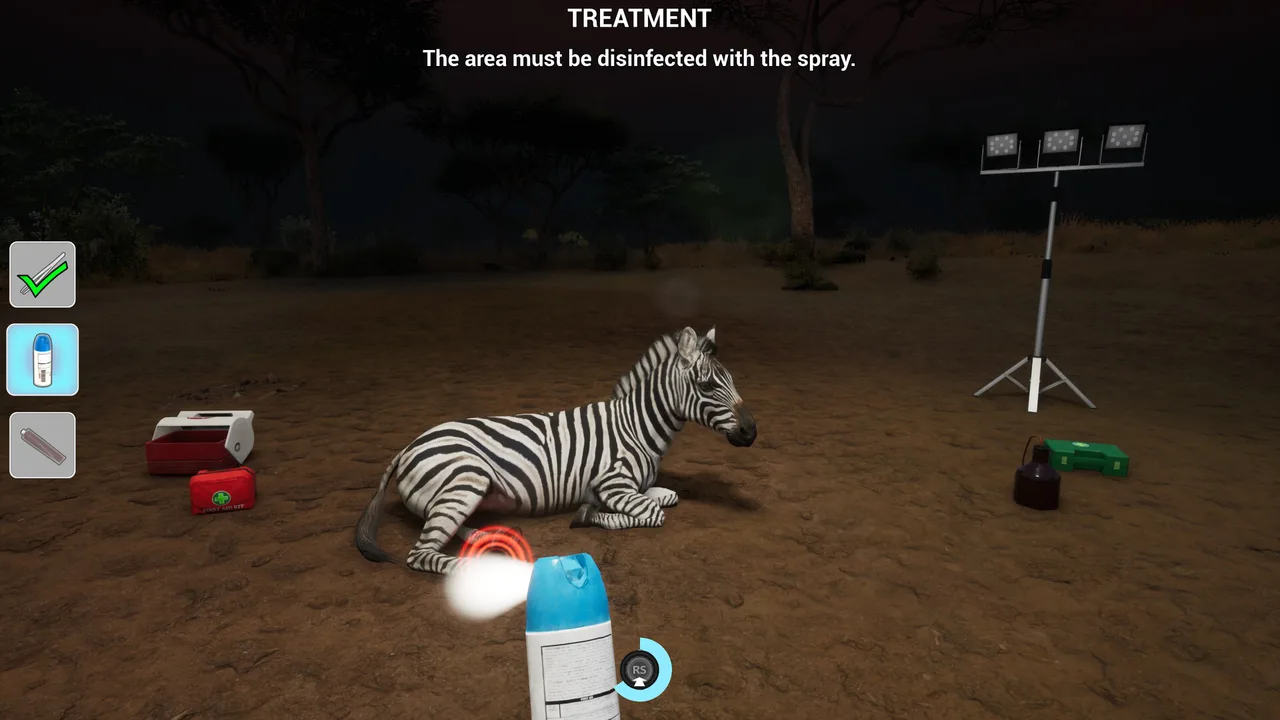
- Assess. Walk up, and the game prompts an examination. In the screenshots the prompt is contextual: hold a trigger to use the magnifying glass, press a face button to confirm, and move a stick to spray a wound or draw a sample.
- Calm the animal. A lion encounter in the press shots opens with a line telling you the animal is too anxious and must be stroked first. The hand icon sits at the top of the tool rail, highlighted in orange, before anything medical happens.
- Treat. The left-hand rail is an ordered checklist. Completed steps get a green tick, the current step glows, and the top of the screen names the action in plain language: clean the wound with a swab, disinfect with the spray, take a blood sample.
- Bank it. A successful treatment pays XP and stars, and the animal goes into the encyclopedia once you have a photo and a diagnosis. Stars are visible in the top-left corner of every screenshot, at 100 and later 875, so they accumulate across sessions.
The tool rail tells you the exact next step. New players lose time staring at a zebra's leg when the game actually wants a blood sample from the neck. If the highlight moved, the previous step registered.
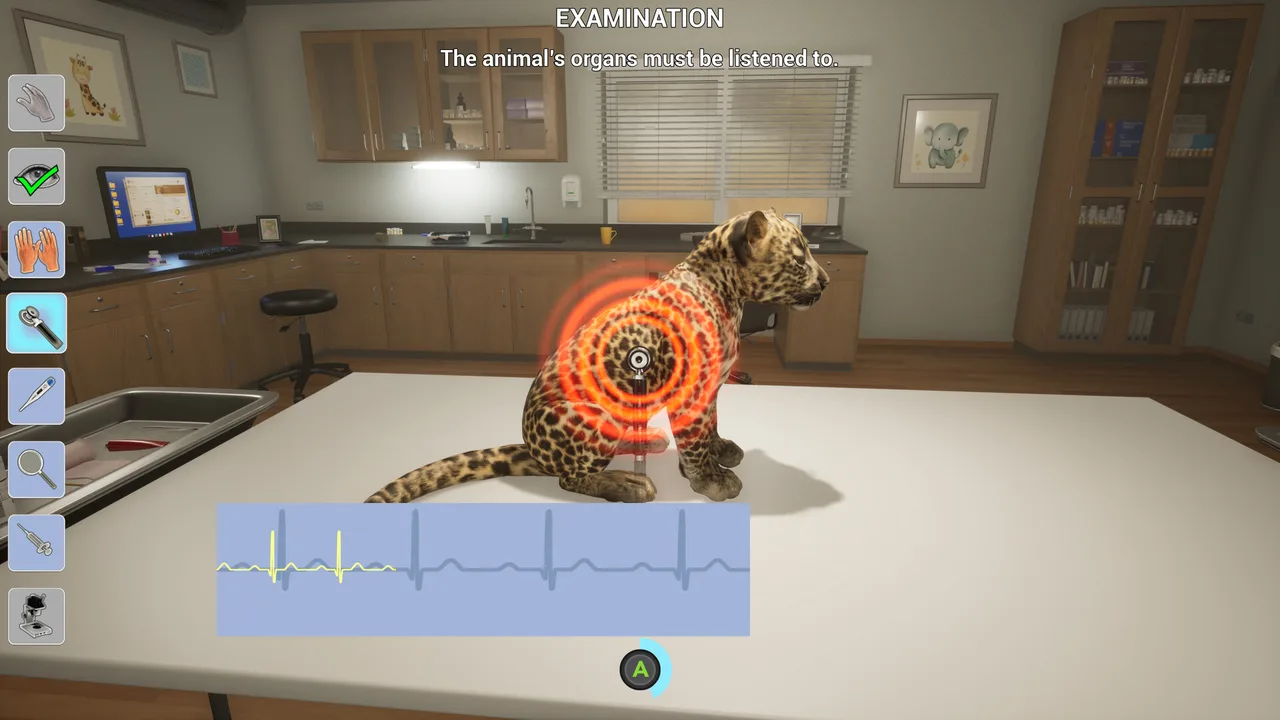
The examination tools visible across the official shots are a stroking hand, an eye check, a palpation/glove icon, scissors or forceps, a plain syringe, a magnifying glass, a sample syringe and a stethoscope. That is eight icons on the rail. Not every patient uses all eight; minor cases like a cut hoof are two or three steps, while the clinic cases run longer.
How much content is there?
More than the price suggests. The store page claims over 120 different illnesses, which is the headline number, and the achievement list backs up the breadth: there are 36 achievements, and 19 of them are tied to treating a specific animal or its baby.
The baby animal cases→ are the part of that content worth knowing before you start.
| What | Number | Source |
|---|---|---|
| Named species | 10 | Steam store description |
| Adult patients in achievements | 11 (lion and lioness count separately) | Steam achievement list |
| Baby patients in achievements | 6 | Steam achievement list |
| Illnesses claimed | 120+ | Steam store description |
| Achievements | 36 | Steam achievement list |
| Photo achievements | 2 | Steam achievement list |
The species named officially are lions, elephants, giraffes, zebras, leopards, gorillas, chimpanzees, crocodiles, hippos and rhinos. The full animal list with babies and treatment notes→ breaks that down by where each one turns up.
How does progression work?
XP comes from successful treatment, and the store description says it feeds your character as well as the practice. The achievements for clothing, hair, shoes, skin, eye colour and hair colour all read "all five unlocked", which tells you the customisation menu has five options in each slot rather than a deep creator. Unlocking all of them is a completion goal, not a fashion simulator.
The clinic is the other half. Seriously ill animals are brought indoors rather than treated in the field, and the leopard screenshot shows an examination table, an ECG readout and a stethoscope step. Field work is the bulk of the game; the clinic is where the harder cases resolve.
That matters for buying decisions more than for play. The PC build is the cheapest right now, and the console versions are the same game at a higher list price. The guide card above has the current numbers with the dates attached.
What is the honest catch?
Three things, and none of them are dealbreakers for the audience the game is aimed at.
The price gap is real. On November 25, 2026, Steam showed $14.99 with a 15% launch discount taking it to $12.74, while Switch and PS5 both showed $24.99. That discount will end, and the PC price will drift back toward list.
The review base is thin. Steam showed three user reviews and no aggregate score when we checked, so there is no crowd verdict to lean on yet. The PlayStation page also read "No ratings".
And the simulation is shallow by design. This is a game for a nine-year-old and a parent, not a veterinary sim for adults who want differential diagnosis. If you want depth, the 120 illnesses are mostly short procedure chains, not systems.
Which version should you buy?
If the child in the house plays on the TV, Switch is the obvious pick: 1.4 GB, handheld and tabletop supported, seven languages including English, French, German, Italian, Spanish and Brazilian Portuguese. If they play on a laptop, Steam is half the price. PS5 sits in the middle: same price as Switch, DualSense support, and a long list of accessibility options including playable without rapid button presses or simultaneous presses.
Everything else, including controls and the photo system, is identical. The platform comparison→ covers load times, file size and store differences in detail.
FAQ
Is My Life: Safari Vet multiplayer? No. Steam lists Single-player only, the Switch page says one player, and the PS5 page says 1 player. There is no co-op and no online mode.
Can a young child play it alone? Yes, with caveats. It is rated ESRB Everyone, has no spoken dialogue to read over, and Steam advertises "Playable without Timed Input". Reading is still required for task text.
How long is the game? No official length is published, and with three Steam reviews there is no reliable player average yet. The 36 achievements and 120+ illnesses suggest a 10 to 15 hour completion, but treat that as an estimate, not a fact.
Does it work on Steam Deck? Valve marks it as Full Controller Support, which is a good sign, but that is not the same as a Deck Verified badge. We have not tested it on Deck and will not claim otherwise.
Official source: Steam store page ↗ Official source: Nintendo eShop listing ↗ Official source: PlayStation Store listing ↗ Official source: Steam achievement list ↗